FISCHER LABORATORY OF GENOME REGULATION
Research

Fischer Laboratory of Genome Regulation

Research

Research

Genome regulation across chromatin, networks and promoter architecture

Four connected programmes examine how transcription factors, chromatin states, cell-cycle complexes and neighbouring promoters control cancer-relevant gene expression.
01

p53-driven chromatin remodelling and enhancer activation

We investigate how p53 accesses closed chromatin, reshapes nucleosome organisation and establishes transcriptionally active enhancers.

The tumour suppressor p53 is a central model for understanding how transcription factors interpret chromatin context. The laboratory combines quantitative genome-wide measurements with targeted molecular experiments to distinguish p53 binding from the downstream steps that create an active regulatory element.

Recent work showed that p53 can act as a pioneer transcription factor at many genomic sites, driving histone modification, nucleosome eviction and enhancer formation. The group now investigates why only selected p53-bound loci proceed to productive transcription and how local p53 abundance, DNA sequence and binding dynamics determine regulatory output.

Graphical summary of p53-mediated chromatin remodelling, enhancer establishment and transcription initiation. Fischer et al., Nucleic Acids Research (2025), open-access research figure.
02

RFX7 tumour-suppressor networks and cofactors

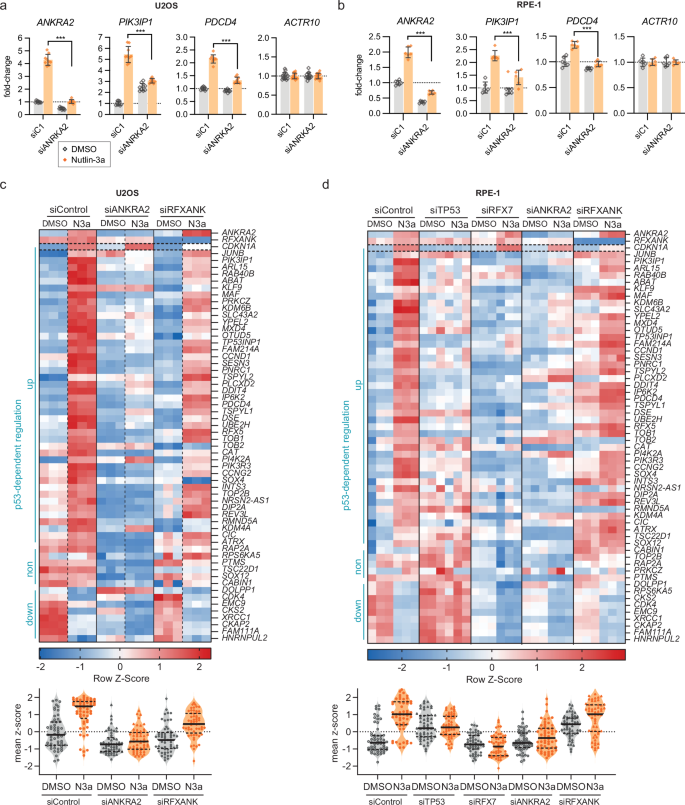
We define how RFX7 transmits stress signals to growth-suppressive genes and how cofactors such as ANKRA2 shape this response.

RFX7 has emerged as an important tumour suppressor and a major downstream component of the p53 response. The group maps direct RFX7 targets and studies how this transcription factor regulates growth, differentiation, metabolism, apoptosis and therapeutic sensitivity.

A central goal is to understand the proteins and promoter elements that control RFX7 activity. Work on the p53 target ANKRA2 identified a functional RFX7 cofactor, while broader multi-omics studies connect the pathway to PDCD4, PIK3IP1, MXD4, DDIT4 and other tumour-suppressive genes.

ANKRA2-dependent regulation of the p53–RFX7 target-gene programme in human cell models. Schwab et al., Cell Death Discovery (2024), CC BY 4.0.
03

Cell-cycle transcription and tumour-suppressor pathways

We map how DREAM, RB–E2F and MMB–FOXM1 coordinate G1/S and G2/M genes and how p53 restrains these programmes.

Precise waves of gene expression drive DNA replication, mitosis and cytokinesis. The laboratory studies how RB-family proteins, E2F factors and MuvB complexes—including DREAM and MMB–FOXM1—organise these waves and prevent proliferation when growth is inappropriate.

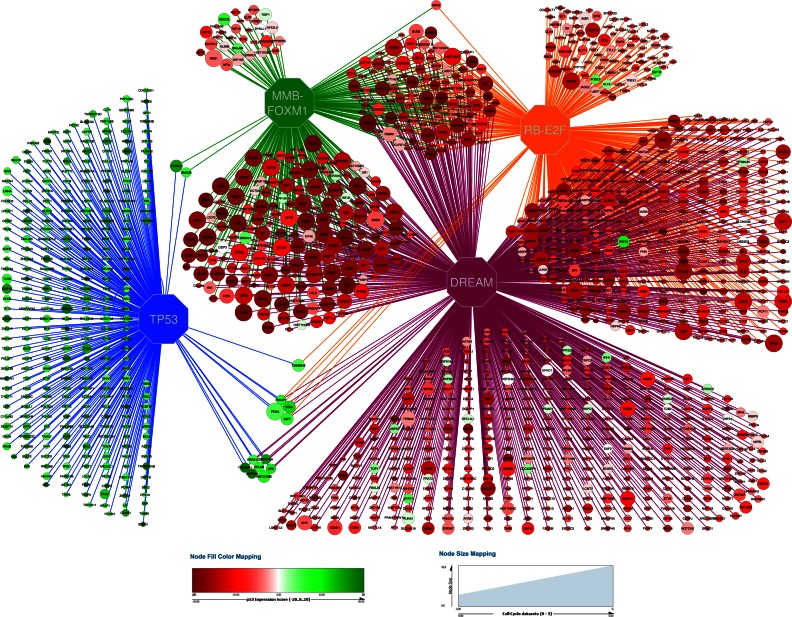
By integrating expression datasets with transcription-factor binding profiles, the group has built high-confidence maps of cell-cycle genes and their regulators. This framework explains how p53 activates p21 and indirectly represses large G1/S and G2/M gene programmes through DREAM and RB–E2F.

Integrated TP53, DREAM, RB–E2F and MMB–FOXM1 target-gene network controlling cell-cycle transcription. Fischer et al., Nucleic Acids Research (2016), open-access research figure.
04

Convergent promoters and transcriptional dynamics

We study closely spaced promoters, antisense transcription and the principles that allow neighbouring transcription units to be co-regulated.

Human promoters frequently sit close to other transcription start sites and can generate coding, non-coding and antisense RNAs. The laboratory investigates how these neighbouring units influence one another and how promoter architecture shapes coordinated gene activity.

Genome-wide analyses identified convergent co-regulated promoters as a widespread configuration in which facing transcription units often change together rather than compete. Current work revisits classical models of transcriptional interference and focuses on the fast temporal dynamics that may allow polymerases and regulatory proteins to avoid persistent conflicts.

Architecture and coordinated expression of divergent, enhancer-associated and convergent transcription start sites. Wiechens et al., Nature Genetics (2025), CC BY 4.0.